AI cybersecurity in fintech means two different jobs wearing one name. The first is using AI to defend, anomaly detection, fraud scoring, alert triage, automated response. The second is defending AI itself, the models, the training data, the pipelines and the third parties that supply them. Most fintechs do the first well and the second badly, because the second did not exist as a risk category when their control framework was written.
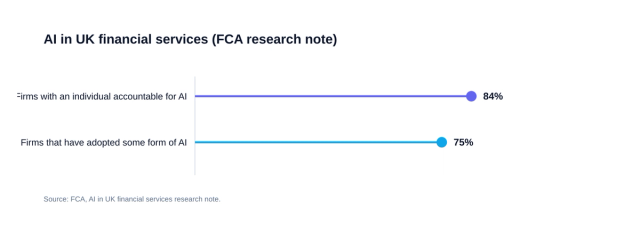
The FCA’s own research found that 75% of UK financial services firms have already adopted some form of AI, and that cybersecurity is the biggest perceived risk among them. This guide covers both jobs, and how to evidence them to a UK regulator.
Executive Summary & Key Takeaways
- AI cuts both ways. AI is used in fintech security for fraud detection, anomaly detection, alert triage and automated response, but the same capability changes the attacker’s economics too.
- Adoption is mainstream. The FCA reports 75% of UK financial services firms have adopted some form of AI and 84% have an individual accountable for it.
- Entry points have shifted. 31% of breaches now start with a software vulnerability, overtaking stolen credentials as the top initial access vector (Verizon DBIR 2026).
- New controls are needed. Securing AI requires controls most fintech frameworks predate: model inventory, training-data governance, third-party AI risk and adversarial testing.
- Regulators treat it as resilience. UK supervisors expect frontier AI to be treated as a resilience issue, not a product feature, the FCA, Bank of England and Treasury said so jointly in May 2026.
How is AI used in fintech cybersecurity?
AI is used in fintech cybersecurity in four main ways: detecting fraud and anomalies at a scale humans cannot match, triaging the alert volume that overwhelms security teams, automating containment and response, and increasingly, generating and hunting for vulnerabilities in the firm’s own code. The same tooling is also being used against firms, which is why adoption and exposure have risen together.

Detecting fraud and anomalies
Machine learning models score transactions in real time, learning what normal looks like for a customer or merchant and flagging deviation. In fintech this is the highest-value use by a wide margin, because the volumes involved make rule-based systems unmanageable and the cost of a false negative is a direct financial loss.
Triaging alerts and automating response
The second use is less glamorous and often more effective: using models to cluster, prioritise and enrich alerts so analysts spend their time on the ones that matter. The IBM Cost of a Data Breach Report 2026 puts the savings from extensive use of AI and automation in security at around USD 1.93 million compared with firms using none, which is a rare, measurable figure in this space (IBM, retrieved 16 September 2026).
Adversarial use: AI on the other side
The same technology is used against financial firms. The IBM report also records a 56% increase in AI-driven attacks, including deepfake impersonation and AI-enabled malware, and notes that an AI model inversion attack costs around USD 6 million on average. Verizon’s 2026 Data Breach Investigations Report found 15% of attack techniques are now bolstered by generative AI, and that click rates are 40% higher on mobile, making phones the preferred target (Verizon, retrieved 16 September 2026).
The 2026 threat picture
The structural shift to understand is that attackers have moved from tricking people to exploiting systems. Verizon’s 2026 DBIR found that 31% of breaches now begin with a software vulnerability, overtaking stolen credentials as the leading initial access vector for the first time, with ransomware involved in 48% of breaches.
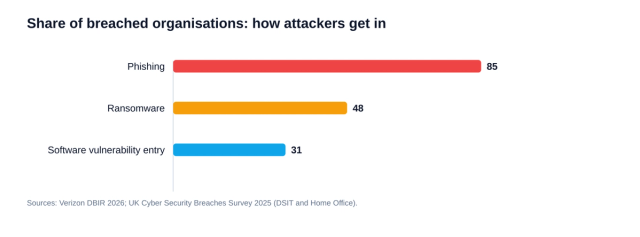
For fintechs, whose entire product is software, that is a direct transfer of risk from the phishing-awareness poster to the build pipeline. It is also why application security and CI/CD controls now determine whether an AI initiative increases or decreases your risk surface.
Where AI creates new risk in fintech
Adopting AI does not just add capability. It adds four risk classes that most fintech control frameworks were not designed to cover.
Model and pipeline risk
Models can be poisoned during training, manipulated at inference, or simply drift as the world changes around them. An inventory of models, their data, their owners and their decision authority is the baseline control, you cannot govern what you cannot list. If you are early in this, our AI and ML security practice covers the control set.
Data risk
Training data is personal data more often than not. Under UK GDPR and the Data Protection Act 2018, and with the Data (Use and Access) Act 2025 now in force, using customer data to train a model needs a lawful basis, retention logic and a breach story. The ICO expects notification of personal data breaches within 72 hours where feasible (ICO, retrieved 16 September 2026).
Third-party AI risk
Most fintechs consume AI through an API, an embedded product or an outsourced service. DORA’s ICT third-party pillar requires contractual provisions, a register of information and concentration-risk awareness. If your AI capability is concentrated in one provider, that is a resilience finding, not a procurement preference.
Adversarial AI and frontier models
As models become capable enough to find vulnerabilities at scale, the patch economics change. The NCSC has published guidance for defenders on frontier AI and a set of ten questions to ask when using AI models to find vulnerabilities, worth reading before you point a model at your own codebase.
Securing AI in fintech: a practical control set
The FCA’s research note found 84% of firms already have an individual accountable for their AI approach, which is a strong start. Accountability alone does not produce controls. These are the ones that turn up repeatedly in our work with regulated firms.
- Inventory every model in production. Name, owner, purpose, data sources, decision authority and last review date. This is the single highest-leverage control.
- Extend threat modelling to AI. Model the pipeline, not just the application. Poisoning, prompt injection, data exfiltration through outputs and insecure plugins all belong in the same threat model you already run.
- Apply existing software controls to AI infrastructure. No new discipline is needed here: the vulnerability management, dependency scanning, secrets handling and CI/CD controls that protect the rest of your estate apply unchanged to model training and serving code. Our CI/CD security work is where a surprising share of AI risk actually lives.
- Govern the data. Map which customer data trains which model, confirm the lawful basis, set retention, and make deletion technically possible. If you cannot delete a customer’s data from a trained model, that is a UK GDPR problem waiting to surface.
- Put AI suppliers through the same third-party process as any critical supplier. Contractual security provisions, incident notification timelines, subcontractor visibility and exit plans.
- Test adversarially. Include prompt injection and model manipulation in your penetration testing scope, and decide which AI-dependent services warrant the advanced testing DORA expects of critical financial services.
- Keep a human decision path. For consequential decisions in lending, onboarding or fraud, document where human review sits and how a model failure is detected and reversed.
- Rehearse the incident. An AI-specific incident, a poisoned model, an exfiltrated prompt log, a supplier outage, needs a playbook, and the playbook needs a rehearsal before you need it.
If your team is small, steps one, three and five give the most risk reduction for the least effort and should come first.
Protecting chatbots, models and training pipelines
Customer-facing AI needs controls at its boundaries. Validate and sanitise inputs to chatbots and LLM features to reduce injection risk, restrict which APIs those features can call, and log interactions so unusual sessions can be flagged. Retrain and re-test models on a schedule, because attackers adapt too.
Keep model infrastructure in separate network segments with zero-trust access, so a compromised service cannot reach training data or model weights freely. Feed pipeline telemetry into intrusion detection, and include ML workflows in red team exercises, not only the public web front end.
Where data is pooled across teams, partners or regions, consider privacy-preserving techniques such as federated learning or differential privacy. They reduce how much raw customer data sits in one place, but they add engineering cost and do not remove the need for a lawful basis.
What UK regulators expect
FCA: AI is a governance and resilience topic
The FCA has run an AI Lab, an AI Consortium, live testing and a Supercharged Sandbox, and has helped over 200 firms through its AI testing and machine learning services. Its consistent message is that existing rules, consumer duty, operational resilience, senior management accountability, already apply to AI, and that firms should be able to explain their approach rather than wait for AI-specific rules.
Frontier AI as a resilience issue
In May 2026 the FCA, Bank of England and Treasury issued a joint statement on frontier AI models and cyber resilience, followed by a multi-firm review in September 2026. CMORG, the Bank’s cross-market resilience group, published frontier AI guidance in June 2026 with 38 key activities and 31 questions. Boards that have not yet asked those questions are behind the UK supervisory curve.
Testing and third parties
CBEST remains the UK’s regulator-led threat-intelligence-led penetration testing framework, and its first thematic analysis of adversary tactics and techniques was published in January 2026. The Critical Third Parties regime lets the FCA, Bank of England and PRA jointly oversee designated critical third parties without removing the firm’s own accountability, including for the AI services it relies on.
Common mistakes
- Treating AI security as a model problem. Most real incidents involve the surrounding pipeline, credentials and suppliers, not the mathematics.
- Letting AI adoption outrun the supplier register. Every AI API is a third party.
- Assuming your existing framework covers AI. If it was written before 2023, it almost certainly has no model inventory or prompt-level threat model.
- Ignoring the data question until an access request arrives. Deletion and retention have to be technically possible, not just documented.
- Testing the model but not the integration. Prompt injection usually lands through the application layer, not the model itself.
Our application security and threat modelling teams cover the integration layer, and our regulatory compliance support maps the evidence to FCA and DORA expectations.
Frequently asked questions
Is AI good or bad for fintech security?
Both, and the net effect depends on your controls rather than the technology. AI improves detection and response at scale, the IBM 2026 report associates extensive security AI and automation with around USD 1.93 million lower breach costs, while simultaneously lowering the cost of attacks and adding new AI-specific weaknesses. The differentiator is whether you govern the models and pipelines.
Do UK fintechs need DORA-compliant AI contracts?
If you supply AI or ICT services to EU financial entities, yes, DORA’s third-party provisions flow through contracts and the client’s register of information. UK-only firms typically see these expectations through their own critical third-party arrangements and FCA operational resilience rules instead.
How is AI regulated in UK financial services?
There is no single AI act for financial services. The FCA applies existing rules, consumer duty, operational resilience, senior managers and certification, and expects firms to explain their AI governance. Frontier AI is being treated explicitly as a cyber resilience issue following the FCA, Bank of England and Treasury’s May 2026 joint statement.
What should a fintech do first with AI security?
Build a model inventory. You cannot govern models, data or suppliers you have not listed, and the inventory immediately exposes concentration risk and unowned decisions. From there, extend threat modelling to the AI pipeline and put AI suppliers through the standard third-party process.
Does using AI affect UK GDPR compliance?
It can. Training on customer data requires a lawful basis, retention logic and a workable deletion path, and the ICO expects personal data breaches reported within 72 hours where feasible. The Data (Use and Access) Act 2025 updated parts of the regime, so revisit your AI data map rather than relying on pre-2025 assumptions.
Getting started
AI is not a bolt-on to fintech security and it is not a separate discipline. It is a new class of asset, models, pipelines, training data, AI suppliers, that needs the same inventory, threat modelling, testing and supplier governance you already apply to everything else. The firms getting this right started with a list.
If you would like help building that list, threat modelling an AI pipeline, or evidencing it to the FCA, talk to our team.

Jared Henderson
Writing about cyber security and technology at Falx.